
Aaa
- DisplayFraunces 9..144
- TextManrope 400..700
- Radius16px throughout
- Rhythm4pt, eight steps
Ink
- Ink
- Sea glass
- Stock
- Sheet
- Rule
Coverage finder live
What do you need to protect?
Landing in the AMS, tagged by line and office
Retail agencies
Specialists and groups
The site
Quotes and upkeep
Engines
Design and build
Lines, search and rebuilds
Draft Proof EditionDesign studio for insurance agencies
Custom coded, designed once for your agency and kept accurate every week after that. Live in 7 days from $127 a month, with a free domain, hosting included, and the $697 build fee invoiced only after launch.
Aaa
Ink
Coverage finder live
What do you need to protect?
Landing in the AMS, tagged by line and office
90+
PageSpeed
Guaranteed on every page we build and host, mobile and desktop.
7 days
to launch
On Draft. 10 on Proof, 15 on Edition.
5 a month
revisions included
Any size each. Then $20 a revision, 2 to 5 working days.
$697
build fee, after launch
Invoiced once the site is live and approved, never before.
Early proofs2 readings
Two of the client reviews on the board further down the page.
Inquiry form and response workflow for commercial coverage reviews
We expected a prettier website; what we actually use every day is the new form. The form gathers business activity, renewal date and coverage question at the start, exactly the details our follow-up messages always requested. The first message is usually enough to act on now.
Mobile navigation and page layout for commercial coverage reviews
Most of our visitors are on phones, so that is where I reviewed the new commercial coverage reviews pages. Key information comes first and the contact option is clearly labeled. It is far more practical than the old page when we share it with a caller.
CorrectionsMarked on the sheet
Each of them costs a policy that never gets written. None of them is visible from inside the office.
What it costs. A prospect cannot tell you apart from the agent two towns over, so the decision falls to price, and price is the one thing an independent agency does not control.
What it costs. Nothing exists for a search engine to rank when someone types "workers comp for a two-person shop", so the search that should find you finds a directory instead.
What it costs. People who were ready to talk close the tab at the VIN question. The few who finish give a producer half of what a first call needs.
What it costs. The visit most likely to become a policy, on a phone outside a dealership or a closing, ends before the page has appeared.
What it costs. A producer who left last spring, a carrier you no longer represent and last winter's hours are all still live, and every one of them reads as neglect.
OverrunsWhat waiting costs
None of this shows up on an invoice, which is why it never gets fixed. These are the five places the money actually goes while an agency website stays as it is. We have not put figures on them, because your book, your market and your ad spend decide the numbers, and you already know them better than we do.
Every prospect who closes a slow page or abandons a twenty-field form was a quote request your producers never saw. You cannot count them, which is exactly why the loss never gets attributed to the website.
If you run any paid search, you have already bought those visits. A page that arrives slowly, or answers a different question from the ad, spends that budget without giving it anywhere to go.
When there is no page about the coverage you write in the town you write it, that search is answered by a lead aggregator, a national carrier or the agency down the road who did build the page.
Referrals, mailers and carrier listings all end at your website. A site that looks two owners out of date undoes the introduction someone else just made for you.
Producer changes, a new carrier, holiday hours, a new program. Whoever ends up owning it is doing marketing admin instead of writing business, and doing it late.
OccasionsSeven searches
Nobody wakes up wanting insurance. Something happens, and an hour later they are typing it into a phone. Your site earns the call by having a page that answers the exact thing that just happened, in the town it happened in.

Homeowners, and usually auto moved across at the same time. They search the day the keys arrive, from a phone, surrounded by boxes.

Workers compensation, and a general liability certificate the general contractor wants before Monday.

Commercial auto, and a conversation about whether the personal policy should have been a fleet policy a year ago.

A business owners policy, with the landlord asking for evidence of coverage before the doors open.

Property, liability, liquor liability and a payroll that has doubled since the last renewal.

A personal auto question that arrives as an evening search and becomes a phone call in the morning.

Inland marine, stock, equipment and the workers comp class codes that come with a forklift.
Photographs: SHVETS production, Rodolfo Gaion, RDNE Stock project, Andrea Piacquadio, Ali Alcantara, Antoni Shkraba, Tiger Lily on Pexels, used under the Pexels License. They illustrate the kinds of business insurance agencies write and are not clients of this studio.
ReviseFive decisions
The fix is never a plugin. It is a decision made once, in the design, and kept for the life of the site.
A carrier template with your logo dropped in
Type, color, spacing and imagery direction are decided once and applied everywhere, so the umbrella page and the claims page look like they came from the same hand.
Twelve lines on one services page
Business owners policy, general liability, homeowners, term life, group health: each gets a page that answers the question a prospect actually typed.
A form that asks for a VIN before a name
It narrows to the right line, collects only what a producer needs to call back well, and lands the request in your AMS with the line tagged.
Four seconds to first paint on a phone
Almost no JavaScript, images sized at build time, served from the edge. The page appears before the doubt sets in.
A site nobody at the agency has time to touch
Send the change in an email. Producers, carriers, hours and lines are kept current within the week, and nobody logs in to a builder.
ImpositionSix outcomes, one bed
The site does the first part of a producer's job, and it keeps doing it after hours.
A site composed from one brand system, in a type and colour that feel chosen, signals that the agency pays attention. That is the impression a commercial buyer or a family shopping for life coverage forms in the first second, and it is the one that decides whether they pick up the phone.
The coverage finder tags each request with the line, the office and the answers given, straight into your AMS.
Producers, carriers and hours are updated within the week from an email. Nobody at the agency logs in.
A page per line and per office, plus two cited articles a week, is how an agency site earns visibility beyond its own name.
Hosting, domain, updates, articles and the finder are inside the plan. The build fee is invoiced only after launch, and 90+ PageSpeed is guaranteed.
Static pages open instantly on weak signal, and the finder takes a request in under a minute with one thumb.
CompareSix lines
The same agency, the same book of business, a different website.
SpecificationSix items, every plan
Six things, all of them on every plan. The build fee is the only other line, and it comes after launch.
Manifest34 items
The whole list, with the plan each item belongs to. Every one is explained in full on the features page, including the problem it solves and what you have to do.
| What you get | Draft | Proof | Edition |
|---|---|---|---|
| A brand system set for your agency | |||
| A page for every line you write | |||
| Office and territory pages | |||
| Light and dark, readable on any screen | |||
| 90+ PageSpeed, guaranteed | |||
| A launch date you can put in the calendar | |||
| Compliance-aware copy on every page | |||
| The coverage finder | |||
| Every request lands in your AMS or CRM | |||
| Routing to the right producer | |||
| A finder that narrows, never advises | |||
| Weekly detail updates | |||
| 5 revisions a month, any size each | |||
| A client portal from day one | |||
| Managed hosting, nothing itemized | |||
| Technical and on-page SEO | |||
| Local and service-area pages for your towns | |||
| Answer-first content for snippets and voice | |||
| Readable by AI assistants | |||
| Structured data on every page | |||
| Researched articles every week | |||
| The ranking commitment in writing | |||
| An AI receptionist on the phone | |||
| An AI chat widget on the site | |||
| SMS, Messenger and Instagram agents | |||
| A2P 10DLC registration filed for you | |||
| A call-analysis PDF for every conversation | |||
| An agent that hands advice to a person | |||
| 3 social image posts and 2 reels a week | |||
| Your Google Business Profile, managed | |||
| A free domain, or keep the one you have | |||
| Migration that keeps the rankings you have | |||
| Your words stay yours | |||
| An exit that gives you your content back |
Ad spendThe mechanism, not a promise
Every page we build and host is guaranteed 90+ on Google PageSpeed, mobile and desktop. That is a design decision first, and a media decision second: a page that opens instantly and answers the search it came from can lower what each click costs you and keeps more of the visitors you are already paying for.
Every click on a paid ad is bought whether or not the page arrives. A prospect standing outside a dealership on a weak connection does not wait for a slow page, and that click is spent either way. Pages that appear immediately keep more of the traffic you are already buying.
Google Ads reports Quality Score from expected clickthrough rate, ad relevance and landing page experience, and Google states that higher quality ads typically cost less per click than lower quality ads. A faster, clearer, mobile-ready page is the part of that you can actually build.
Google advises keeping the message consistent from the ad to the page and making the page relevant to what the person searched. An agency site with a page for workers compensation, one for commercial auto and one for homeowners can do that. A single services page cannot.
Mobile ease of navigation is part of what Google tells advertisers to work on, and it is where most insurance searches start. Our pages are built mobile first, with the coverage finder taking a request in under a minute with one thumb.
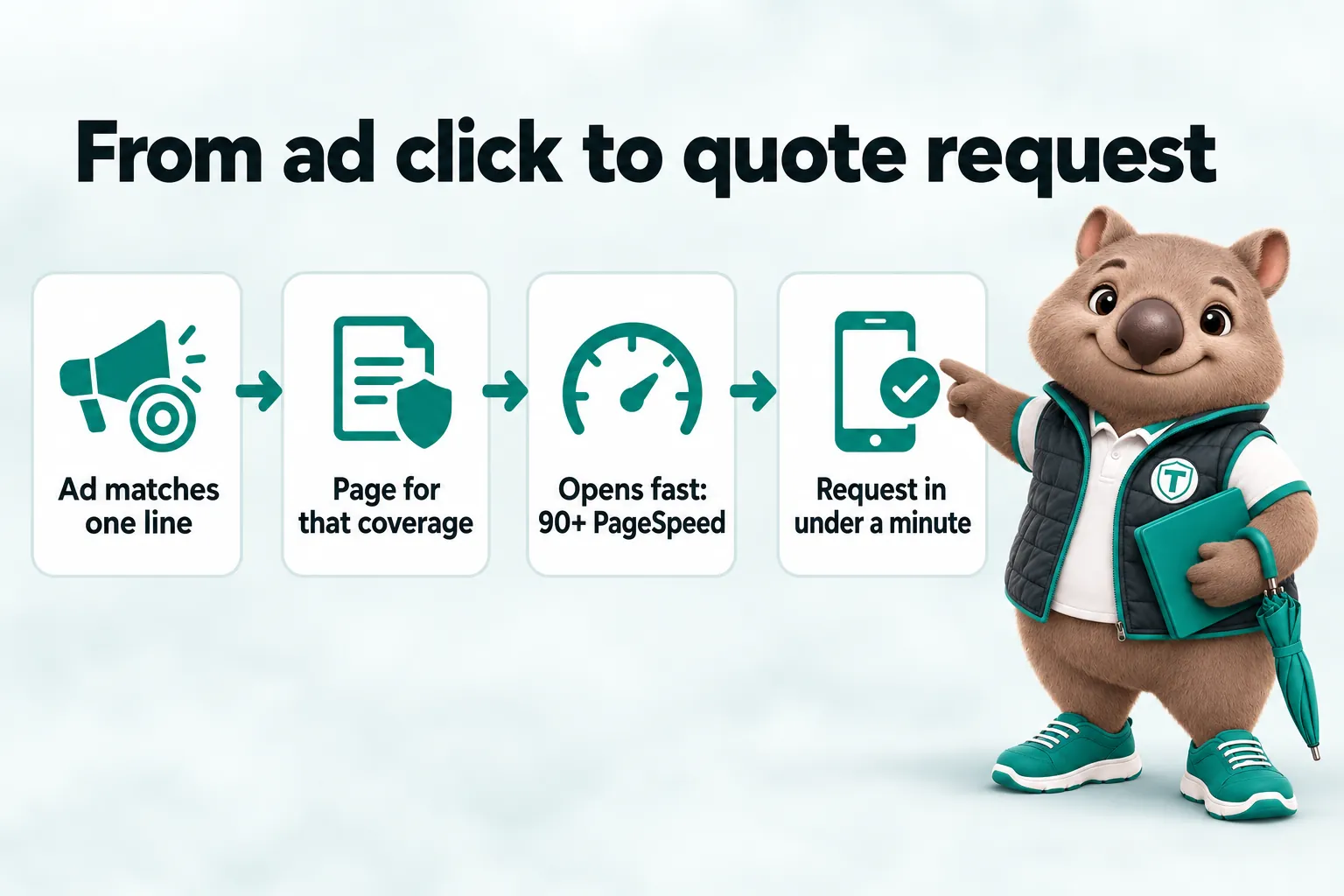
We will not put a number on it. Nobody can tell you in advance how much a cost per click will move, because the auction depends on your keywords, your competitors and your bids as well as your page. What we can commit to in writing is the speed of the pages and the relevance of the page a given ad points at.
VisibilityFour disciplines
Most agency websites rank for the agency name and nothing else. These four things are how a site earns visibility for the coverages you write, in the United States towns you write them, and how it stays readable to the assistants people now ask first. No one can guarantee a place in an AI answer or a search result; this is the work that makes it possible.
Search engines rank pages, not agencies, so we give them pages worth ranking.
Featured snippets, voice answers and results panels quote the page that answers first.
Buyers ask an assistant before they ask a person, and an assistant can only repeat what it can read.
Schema tells a machine what a page is, rather than leaving it to guess.
The local pages are built on your website, for your towns. We do not build city pages for ourselves on this site, because a page written to catch a search rather than to answer one is exactly what search engines have spent a decade filtering out.
GuaranteedTwo promises in writing
Every page is guaranteed 90+ on Google PageSpeed, mobile and desktop, on every plan.
Pages are built as static HTML with almost no JavaScript and served from Cloudflare's edge. Images are sized at build time and fonts load with a fallback so the copy is readable before the display face arrives. A prospect on a phone sees the page, not a spinner, and that is the first design decision they notice.
The site starts ranking for local searches within 3 to 5 months of launch, or we keep working at no additional charge.
A page per line of business, a page per office and territory, 2 researched articles a week and structured data on every page give search engines something specific to index. Most agency sites rank for their own name. Yours is built to rank for the coverages you write in the places you write them.
In writing
Four commitments you can hold us to, and four things we will not pretend to be. The second list is the more useful one.

Limits
Press runSheet 1 to 4
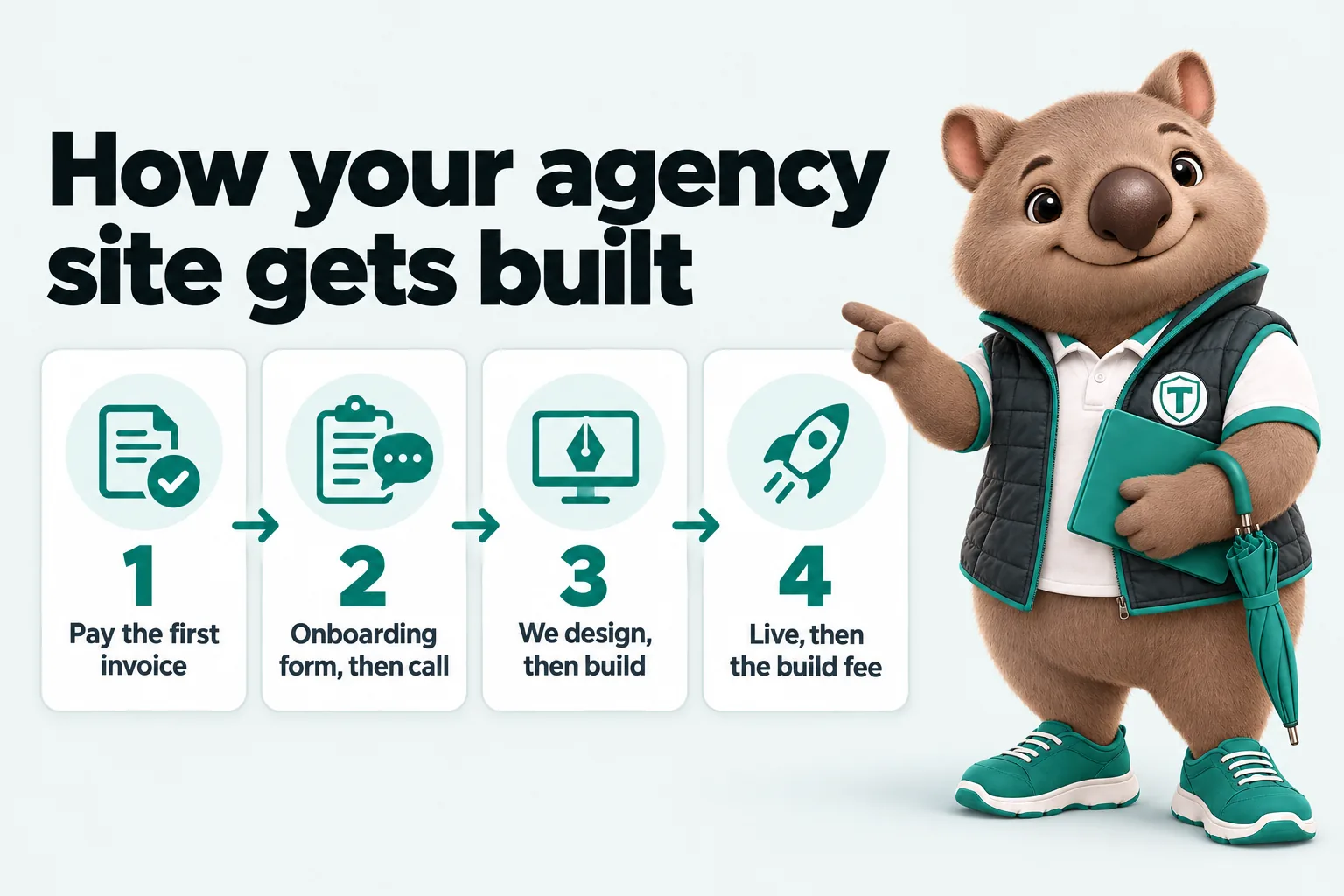
Every stage lands on the one before it. The build fee comes last, after you have approved what is on the sheet.
That is the whole commitment to start. No build fee, no deposit. The plan begins and a designer at the studio is assigned to your build.
Fill in the form with what you have; anything missing follows later by email or a portal ticket. One call fills the gaps and confirms the lines, carriers and offices.
The brand system comes first, then the pages, then the coverage finder configured for your lines. You review a private preview. Your current site stays live throughout.
On launch day the domain switches, old URLs redirect and the sitemap goes to Google. Once you have approved the live site, the $697 build fee is invoiced. Weekly updates begin the same week.
Launch by plan
TerritoryUnited States
We work remotely with insurance agencies in every state, and the site we build is shaped by where you write rather than where we sit. These are states we are asked for most often, and the kind of question your own pages answer in each.
contractor, fleet and hail-season questions on commercial pages written for owners, not underwriters
windstorm, flood and condo association questions answered in plain language before a quote request
wildfire exposure, non-admitted placements and the wording a producer has to be careful with
commercial pages for city trades, and disclosure wording set the way your compliance officer wants it
multi-office agencies with one page per office and a producer named on each
fast-growing suburbs where personal lines and small commercial arrive from the same search
Medicare and benefits pages that stay readable for the people actually reading them
agency networks and clusters holding one design system across member agencies
independent agencies replacing a carrier-supplied template with their own brand
territory pages for the counties an agency writes without an office in every town
Your site carries a page for every office you run and a service-area page for the towns and counties you write in, each written for that place rather than duplicated with the name swapped. Licensing, appointments and where you can actually write remain entirely yours: we build the pages, you write the business.
LedgerWhere the money goes
Comparing a monthly fee with a one-off build price is the wrong comparison. This is the full list of what an agency website actually costs over a year, and who carries each line. Put your own numbers against the left column; we have not invented any.
| Line | The usual arrangement | IWS |
|---|---|---|
| Design and build | A project fee, paid up front, then quoted again for the next redesign | Inside the monthly fee. The $697 build fee is invoiced only after the site is live and approved |
| Hosting, SSL, backups, monitoring | A separate bill, renewed annually, usually forgotten until it fails | Included, never itemized |
| Domain | A renewal on somebody's personal card | Free while the plan runs, registered in your name, or point the one you have |
| Changes during the month | An hourly invoice, or they simply do not happen | 5 revisions of any size a month, then $20 each, completed within 2 to 5 working days |
| Small corrections | Someone at the agency, in the evening | Weekly detail updates, which never touch your revision count |
| Articles | Promised at launch, three posts later abandoned | 2 researched, cited articles a week, every week |
| Speed and search structure | Hoped for | 90+ PageSpeed guaranteed, and the search work continues at no charge if local rankings have not arrived within 3 to 5 months |
Plans start at $127 a month on Draft, $267 plus usage on Proof and $647 on Edition. The full breakdown is on the pricing page.
Print runMonth 1 to month 12
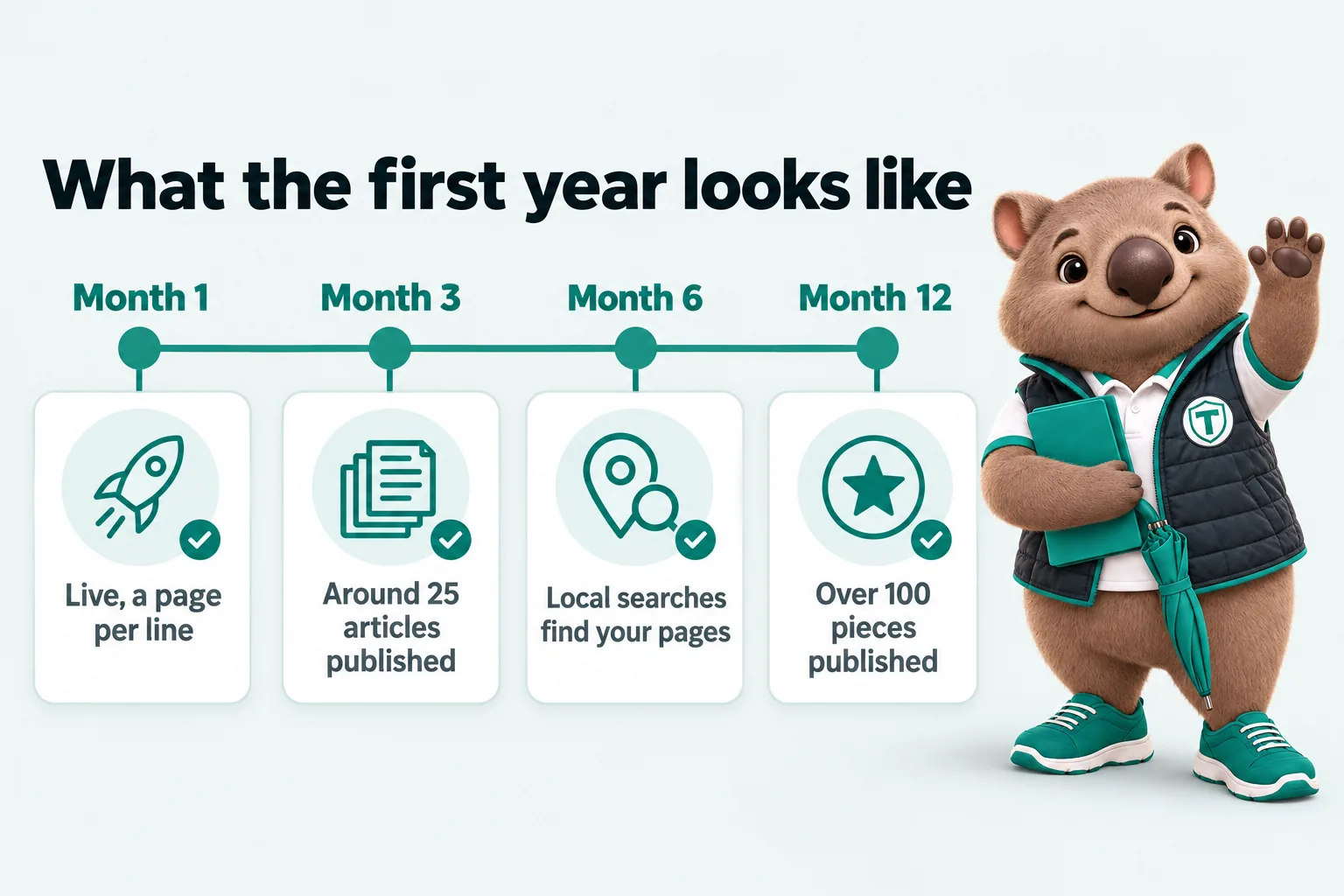
Concrete, from the terms in your plan rather than from optimism.
The site is live, every line you write has a page, each office has a page, and quote requests are arriving in your management system tagged by line. The $697 build fee is invoiced, after launch, not before.
Around twenty-five researched articles are published, the team page is still correct because three producer changes went through as weekly updates, and the finder has been tuned twice from what real requests look like.
Local searches for the coverages you write are finding pages rather than a directory, the article library answers most of what your producers get asked, and nobody at the agency has logged in to anything.
Over a hundred pieces published, a page for every program you added during the year, and a site that still looks like the one you approved because the brand system never drifted.
StatesDraft, Proof, Edition
Every plan carries the designed site and the finder. Proof and Edition add the engines. The $697 build fee is the same on all three and is invoiced once the site is live.
The website, fully managed
The designed site, the coverage finder, weekly updates and two researched articles a week, fully managed.
Everything, plus the AI Engine
Everything in Draft plus the AI Engine: phone, chat and messaging answered around the clock and handed to a producer.
Everything, plus the Content Engine
Everything in Proof plus the Content Engine: three articles, social posts, reels and a managed Google Business Profile.
5 revisions a month included on every plan, requested from your client portal, then $20 each. Free domain and Cloudflare hosting on every tier.
ImprintEight items
Every site we build ships with the pages and the wording an agency website is expected to carry, written for your site rather than generated, and kept current as part of the weekly updates. They help you meet what is expected of you. They are not a substitute for your own counsel, and we do not give legal advice.
Written for your site rather than pasted from a generator: what the forms collect, who processes it, how long it is kept and how somebody asks for a copy or a deletion. Built with the California Consumer Privacy Act as amended by the CPRA and state privacy laws in Virginia, Colorado, Connecticut, Texas and the other states that have passed one in mind.
What the site is, what it is not, and the limits on relying on anything published there. It states plainly that the website does not quote coverage or confirm eligibility.
A consent banner that holds analytics and marketing tags until a visitor agrees, and a cookie page that lists what the site really sets. A banner that blocks nothing is worse than none.
Your conformance target stated in public, with a route to report a problem. The site is built with WCAG 2.2 Level AA in mind: contrast checked in both themes, real keyboard operation, visible focus, labelled forms and text that scales.
The wording your carriers and your compliance officer require, placed as part of the design system so it appears on every page that needs it and is changed everywhere at once when it changes.
Your agency name, your offices and your licensing information presented the way your state department of insurance expects to see it, kept current as part of the weekly detail updates.
Any form that asks to text or call carries the consent language it needs, and the A2P 10DLC registration for business texting is filed for you on the plans that include the AI Engine. Built with the Telephone Consumer Protection Act, for any form that asks to text or call in mind.
The coverage finder narrows and collects; the AI agent takes details and books a producer. Neither quotes a premium, confirms eligibility or recommends a limit, and both say so where a visitor can read it.
InsuranceWebStudio is a website design and management studio and is not an insurance agency, broker, carrier or licensed producer, a law firm or a compliance consultancy. Send us the wording your carriers and your compliance officer require and we will build the site around it.
The board8 readings
Real reviews from 8 of the agency and broker teams we have built for, in their own words.
Now on the board
We expected a prettier website; what we actually use every day is the new form. The form gathers business activity, renewal date and coverage question at the start, exactly the details our follow-up messages always requested. The first message is usually enough to act on now.
Most of our visitors are on phones, so that is where I reviewed the new commercial coverage reviews pages. Key information comes first and the contact option is clearly labeled. It is far more practical than the old page when we share it with a caller.
We handed over a folder of our real commercial coverage reviews replies and let them work from that. They identified which questions belonged on the site and we checked every answer before launch. Pointing people to the page has replaced hunting through old emails.
We used to get regular calls asking whether a commercial coverage reviews message had arrived. The new confirmation states what happens next and how to amend anything that needs changing. It is a small corner of the site that makes the whole process feel finished.
The commercial coverage reviews preparation page does one job and does it well. It tells people what to have ready before we speak, without demanding everything up front. First conversations are shorter and better because of it.
We took the wording about commercial coverage reviews seriously, and I am glad we did. The boundaries are drawn clearly: what the site settles, and what our people still decide. Correcting the site's accidental promises is no longer part of our calls.
Our old commercial coverage reviews routine was a shared inbox and crossed fingers. Requests are assigned automatically, with a backup for when the owner is away. The website and our way of working finally match.
The old commercial coverage reviews PDF made sense on a printer and nowhere else. Each section has its own link, so answering a question no longer means attaching the whole file. A printable copy still exists for those who ask.
Next Book a demo
A live walk-through, on your screen, of the site you would get: your lines, your offices, your finder.
QueriesAnswered on the sheet
Agencies that care how they look and write more than one line. Independent multi-line shops, commercial specialists, personal lines agencies, life and health, Medicare agents, benefits brokers, captive agents, wholesalers and MGAs, specialty programs and agency networks. Each has its own page under Who we build for, with the pages and the coverage finder configuration that fit that book.
A short guided path on your site. A prospect chooses what they need to protect, answers two or three plain questions, and the finder points them to the right line of business and a quote request with only the fields your producers need. The submission lands in your AMS or CRM by API, Zapier or Make, tagged with the line, so nobody retypes it.
No. Every site starts from a design system we set for your agency: type scale, color, spacing, imagery direction and the layout of a coverage page. The structure underneath is shared across our builds because it is fast and proven, but what a visitor sees is composed for your agency and your lines, and it stays consistent from the home page to the last carrier page.
Never. We are a website design and management studio, not an insurance agency, broker, carrier or licensed producer. The coverage finder narrows a prospect to the right line and collects a quote request; every rate, eligibility answer and recommendation comes from your licensed people. Pages carry the disclaimers your compliance requires and we write nothing that reads as advice.
You fill in the onboarding form: your lines, carriers, offices, producers, AMS or CRM, and any brand assets you have. Submit it with whatever you have ready; anything missing can follow later by email or as a ticket in your client portal, and it never holds up the build. Next comes one onboarding call to fill any gaps and confirm the launch date, then we design and build.
Yes. A layout change, a new section, a different imagery direction or a rework of the coverage finder all count as a revision like any other. Larger redesigns that change the whole brand system are scoped separately in writing so you know before we start, but nothing about the monthly fee stops you evolving the design as the agency grows.
You can. Some agencies ask to review every piece for compliance, especially in life, health and Medicare; others let us publish on a schedule and skim afterwards. Tell us on the onboarding call which you want. Either way, you can ask us to correct, revise or remove any article at any time, and corrections are handled within the week, outside your revision count.
Yes. Every page we build and host is guaranteed 90+ on Google PageSpeed for mobile and desktop. Sites are hand-coded, static pages with almost no JavaScript, images sized and compressed at build time, and served from the edge. If a page we built falls below that score because of our work, we fix it at no charge. The guarantee does not cover third-party embeds you ask us to add.
It stays live until launch day. We build on a private preview, you review it, and when you approve we switch the domain over. The switch takes minutes, old URLs redirect to their new equivalents, and Google is told about the move through the sitemap. There is no period where prospects see a broken or half-finished site.
Not if the move is done properly, and that is our job. We map every existing URL to its new page, add 301 redirects, keep page titles that were working, and submit the new sitemap on launch day. The new site is faster and structured with a page per line and per office, and the ranking commitment in your plan applies from launch: if local rankings have not arrived within the window, the search work continues at no additional charge.
Edition Ready for press
Book a demo and we will walk through the site you would get, in your colours, with your lines. Or email and a person replies within one working day.
InsuranceWebStudio uses the cookies below. Necessary cookies keep the site working and cannot be turned off.
Saved on this device only. Press Esc to close.