Draft
The website, fully managed
Live in 7 days. 2 articles a week.
Details and priceRetail agencies
Specialists and groups
The site
Quotes and upkeep
Engines
Design and build
Lines, search and rebuilds
A wholesale brokerage or MGA website serves retail agents, not the public, so it has to publish appetite clearly, make submission intake painless, and look like the kind of partner a retail producer wants to place business with.
Corrections
Appetite lives in a PDF from two years ago and retail agents call to ask what you will write.
Submissions arrive by email in every format, and the intake team retypes them into the system.
Programs are listed by name with no detail on class codes, limits or territories.
The site looks like a placeholder, which retail producers read as a sign of how the account will be handled.
Contents
Each in the brand system we set for you, each written for wholesalers and mgas rather than adapted from a generic agency page.
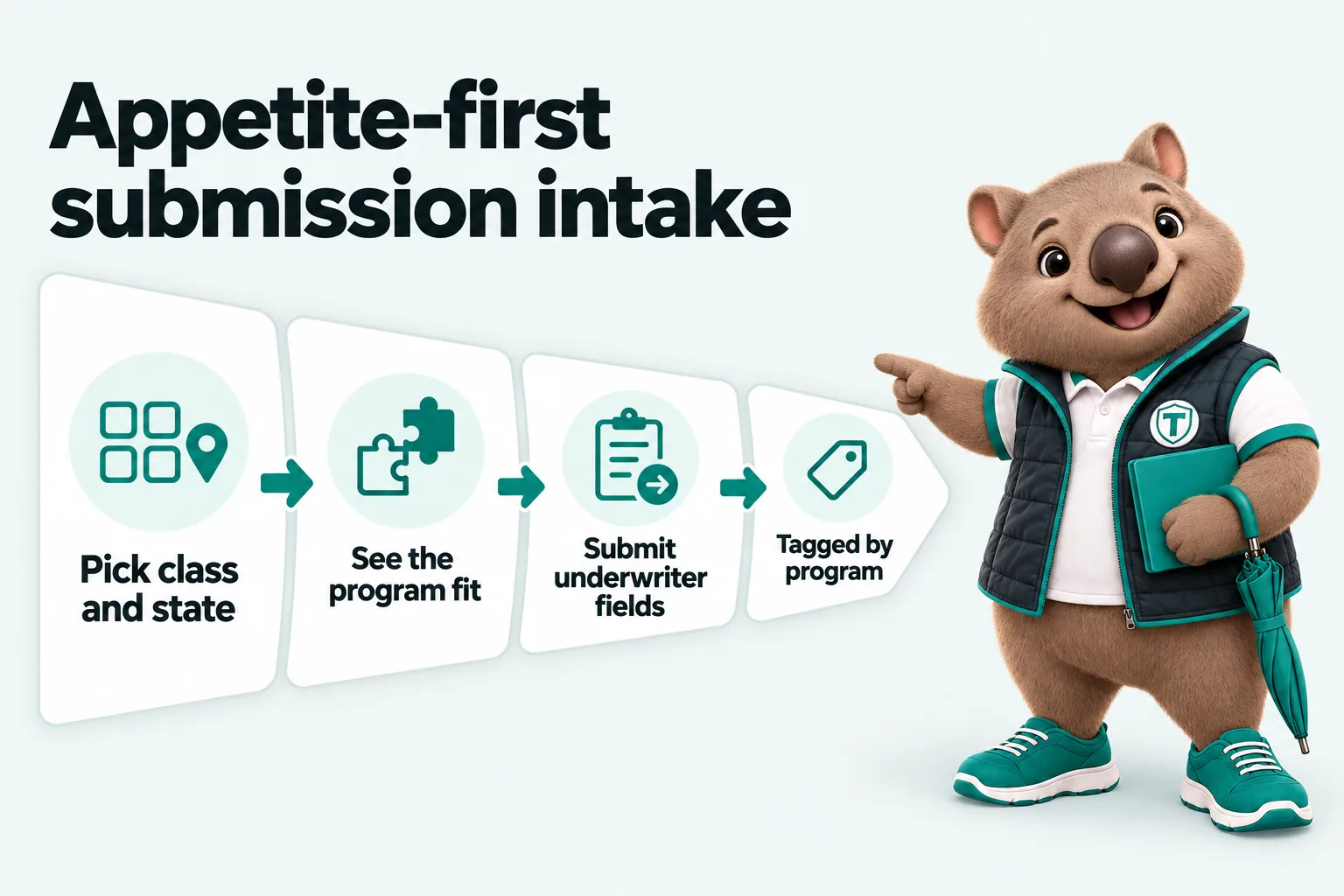
For a wholesaler the finder becomes appetite-first intake. A retail agent picks the class, state and rough size, sees at once whether it fits a program, and submits the risk with the fields your underwriters need. The submission lands in your system tagged by program with the agent's details attached.
The finder narrows and collects. It never quotes a premium, confirms eligibility or gives advice; every answer of that kind comes from your licensed people.
States Draft, Proof, Edition
Every plan carries the designed site and the coverage finder configured for wholesalers and mgas. Proof adds the AI Engine, Edition adds the Content Engine.
The website, fully managed
Live in 7 days. 2 articles a week.
Details and priceEverything, plus the AI Engine
Live in 10 days. 2 articles a week.
Details and priceEverything, plus the Content Engine
Live in 15 days. 3 articles a week.
Details and price5 revisions a month included on every plan, then $20 each.
Included34 items
The same package on every plan, with the coverage finder configured for wholesalers and mgas. Proof adds the AI Engine and Edition adds the Content Engine.
| What you get | Draft | Proof | Edition |
|---|---|---|---|
| A brand system set for your agency | |||
| A page for every line you write | |||
| Office and territory pages | |||
| Light and dark, readable on any screen | |||
| 90+ PageSpeed, guaranteed | |||
| A launch date you can put in the calendar | |||
| Compliance-aware copy on every page | |||
| The coverage finder | |||
| Every request lands in your AMS or CRM | |||
| Routing to the right producer | |||
| A finder that narrows, never advises | |||
| Weekly detail updates | |||
| 5 revisions a month, any size each | |||
| A client portal from day one | |||
| Managed hosting, nothing itemized | |||
| Technical and on-page SEO | |||
| Local and service-area pages for your towns | |||
| Answer-first content for snippets and voice | |||
| Readable by AI assistants | |||
| Structured data on every page | |||
| Researched articles every week | |||
| The ranking commitment in writing | |||
| An AI receptionist on the phone | |||
| An AI chat widget on the site | |||
| SMS, Messenger and Instagram agents | |||
| A2P 10DLC registration filed for you | |||
| A call-analysis PDF for every conversation | |||
| An agent that hands advice to a person | |||
| 3 social image posts and 2 reels a week | |||
| Your Google Business Profile, managed | |||
| A free domain, or keep the one you have | |||
| Migration that keeps the rankings you have | |||
| Your words stay yours | |||
| An exit that gives you your content back |
Wording
Appetite guides describe what you will look at rather than promising terms, submission pages collect information without quoting, and nothing published implies a binding authority you have not granted.
Your site also ships with a privacy policy, terms, a cookie policy with consent that genuinely gates scripts, and an accessibility statement. They help you meet what is expected of you; they are not legal advice, and we are not an insurance agency, broker, carrier or licensed producer.
Proofs3 readings
Real reviews from agency and broker staff, in their own words and named with their permission.
Inquiry form and response workflow for commercial coverage reviews
We expected a prettier website; what we actually use every day is the new form. The form gathers business activity, renewal date and coverage question at the start, exactly the details our follow-up messages always requested. The first message is usually enough to act on now.
Mobile navigation and page layout for commercial coverage reviews
Most of our visitors are on phones, so that is where I reviewed the new commercial coverage reviews pages. Key information comes first and the contact option is clearly labeled. It is far more practical than the old page when we share it with a caller.
FAQ research and editorial review for commercial coverage reviews
We handed over a folder of our real commercial coverage reviews replies and let them work from that. They identified which questions belonged on the site and we checked every answer before launch. Pointing people to the page has replaced hunting through old emails.
Yes. Appetite changes are weekly detail updates: you send the change and it is live within the week, on the program page and in the finder's routing.
It can sit alongside it. Agents who prefer email keep emailing; agents who use the site submit structured data that lands in your system without retyping.
Public appetite and program pages are the norm because they bring new retail relationships. Where forms or rate guides must be restricted, a producer resources area behind a simple login can be added as a revision.
Entirely. The vocabulary is class codes, limits, admitted status and submission requirements, in a design that looks like a serious market rather than a consumer landing page.
Retail partners, almost entirely, and the structure should say so within a second. Appetite, submission requirements, turnaround expectations and who to call, with no consumer-facing quote path muddying it.
Detailed enough to stop three emails: classes, limits you will look at, states, and what you will not write. Appetite changes are weekly updates, so the page can be current in a way a PDF never is.
Yes. Submission intake is pushed by API, Zapier or Make into the system your underwriters use, tagged with the program and the class so nothing is retyped.
Yes, and it is usually the right structure: each program has its own page, its own appetite and its own intake, which is also how a retail agent searches for it.
Also built for
Next Book a demo
A live walk-through, on your screen, of the site you would get: your lines, your offices, your finder.
InsuranceWebStudio uses the cookies below. Necessary cookies keep the site working and cannot be turned off.
Saved on this device only. Press Esc to close.